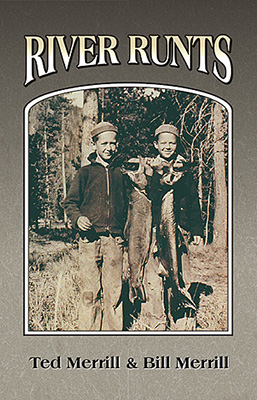

Excerpts from River Runts
A good day and bad
at the Three Falls

The Three Falls was perhaps the second best place on Yankee Fork for blind snagging. It was a quarter mile or so below the Upper Falls, that spectacular theater of team snagging and broken lines, and was a less breath-taking place but fine nevertheless. Here, in the midst of the rapids, the stream abruptly dropped some four feet over a broad ledge. Most of the water was channelled between large boulders into a roaring fall and a frothy pool, which tailed out quickly into a gentle riffle and then more rapids. As you stood thigh-deep in this riffle and faced the fall, at your left were two minor diversions of the current that dashed merrily over the same ledge and made their separate ways through the rocks to rejoin the main stream. By standing on a stone slab just beside the pool you could cast up and across and sweep the hook into deep water where the fish were wont to lie.

I had become reasonably adept at the various aspects of salmon fishing, and when Dad was serving as guide to a party of fishermen, Bill or I regularly accompanied him as assistants and participants in the job. The deal was that for five dollars we would guarantee that the party had a fish to take home or no pay, and that we would try to help them catch one themselves.

We were fishing the Three Falls; Dad was snagging and showing the customer how, while I stood by with the gaff. Suddenly dad hooked a good big fish, probably twenty pounds, and I quickly waded out into position in the riffle below. The salmon gave a short rush toward the falls and hung there in deeper water for a few moments; then, jumping clear of the water and somersaulting once, he churned down toward me. I gaffed him all right, just behind the head, and with the fish thrashing back and forth but suspended safely by the gaff I waded toward the shore some eight feet away. Halfway there the fish's movement threw the weighted snag hook from his side, and at the same instant my foot slipped off a rock. I didn't fall, but in trying to right myself I let the gaff turn and drop a few inches, and the fish splashed into the water between my legs. In vain I lashed at the hole in the water as he vanished.

The entire act had scarcely spanned a minute, and the customer, having just seen his first live salmon, stood open-mouthed. Dad said nothing at first, then made some remark intended to be consoling and encouraging to both me and our guest. Having gotten the idea in a hurry, the man tried his hand at snagging. I stood in the tail of the foam, trying to let the water that was pulling at my knees wash away my humiliation. I only hoped that he would hook one so that I could redeem myself.

I had not long to wait. Within five minutes he was attached to a fish, and a big one—definitely bigger than the first, a stout male with red sides. I braced myself as he came bearing down toward me angling off to the right.

A big fish hooked near the tail and aided by the current hardly seems to be impeded much by a mere man connected to him by a line, and this fish was moving fast; I shouldn't have tried to take him from there, but I did. The gaff sank home, but too far back near the middle of the fish. I lifted him from the water, a glorious beast with his huge mouth wide open, the hooked nose pointing to the sky and the hot afternoon sun flashing from his belly. Then the fisherman unexpectedly heaved back on the rod; the fish's broad tail swung sharply upward, pivoting him on the gaff and at the same time flipping the snaghook free. To my horror the weight was lifted from the gaff and the fish continued his curving trajectory to plunge back into the pool.

I was too old to cry, but inside I wept bitter tears. This time a palpable tension filled the air, and the curses, though muted, were plainly for me. I retired to the rock, and someone firmly relieved me of the gaff.

I'm not quite clear on what followed—whether the guest hooked another or whether Dad hooked it for him and handed him the rod. It was a smaller fish, not nearly so grand as the others. Dad gaffed it and firmly clutched its jaw with his other hand while be hrought it ashore. The guarantee was fulfilled, and the man was quite gracious about the whole thing (he also took home another fish that we had on hand as well). Dad passed it off, as best he could, as just one of those unlucky breaks. But it took more than one fish successfully landed to restore fully my confidence in my place as a member of the team.

Prairie Creek

Prairie Creek flowed, and perhaps still flows, into the Big Wood River a few miles above Ketchum. There was a Forest Service ranger station nearby. I remember clean white buildings with green roofs, a flag pole, and the only patches of green lawn we would see all summer. Memories of that summer are vignettes, bits of people, bits of stream, big black and white dog, bits of seven-year-old encounters. That summer created its share of family lore, confusing memory with later story telling but not clouding the sharpest images.

It was the summer of 1932, and holds the first recollections I have of fishing with my brother Ted independently of our father. The terms set for this stunning degree of freedom and their implementation have in retrospect told me volumes about our parents and their views of parenting. Our unaccompanied ventures along Wood River were subject to two and only two rules: we could fish where we liked as long as 1) we stayed constantly within sight of each other, and 2) we always told the folks whether we were going upstream or downstream.

We clearly understood the logic of these rules. Their absolute nature was impressed upon us one day when we returned to camp from the wrong direction. We had, with due notice, set out upstream. After an hour or so, the river being suddenly devoid of fish, we passed the camp and fished downstream. Since the folks were napping, we decided not to disturb them. It was a mistake in judgement, a failure properly to order priorities, which we did not make again. As I recall, we were asked to consider the relative importance to our parents of being awakened from a nap, or vainly searching for us in the wrong direction.

Our camp near the junction of Prairie Creek and Wood River was in an open stand of lodgepole pines. Across the river were occasional wide grassy meadows in which sage grouse dwelt. Young sage grouse, properly dressed and cooked as our mother cooked them, is a gourmet delight rarely equalled. So our father would from time to time venture against them, armed with a .410-gauge pistol. A meagre weapon, to be sure. The only birds likely to fall prey to such a gun are undisturbed sage grouse and caged canaries. The former, however, have such a myopic view of life and such lousy judgement about when to fly that they quite often graced our table.

Mythology has it (and probably rightly so) that the sage grouse, in order to be edible, must be field stripped the moment it is killed. This field stripping, as taught to us by our father, goes like this: After making sure that the fallen bird is dead, one takes the tail feathers in the left hand close to the body, and inserts the right forefinger in the bird's anus. A quick rip, and the viscera can be slung out onto the ground with a minimum of fuss. (This prevents the sage leaves in the bird's digestive tract from over-spicing the flesh before it is cooked.) And thereby hangs a tale:

A teaching colleague of our father's, a rather dainty and fastidious man, came to spend a few days with us at our Prairie Creek camp. While there he expressed the desire to hunt sage grouse, the ideal beginner's game. Dad carefully instructed him in the use of the pistol and in the care of the game. (Fixed ritual in our family required that the one who killed the game cared for it afterward, and no exceptions could be allowed for guests.)

We set off through the tall grass of a nearby meadow, Dad and Ted and I in a row as beaters, with our guest in the center of the line. A flock got up at our feet, our guest fired, a bird fell. He raced after it and picked it up. There was nothing for it, so he upended it and with infinite distaste inserted his forefinger, crooked it, and prepared to rip. The bird few away.

Now this was no ordinary sage grouse. No succulent young dinner, it was a veritable Ulysses of its race. It was huge and gray and old, a sire of sires. It had a two-inch beak and three-inch spurs, and wing joints like hickory cudgels. Hooked on our hapless guest's forefinger, it led him at a dead run across the meadow. He would pull the bird to him, get beaten and spurred, and allow the bird to carry him on. Collapsed in laughter, we couldn't have helped if we would. My memory goes no further. Our guest runs off the edge of the years, the great grouse leading him by his arm, while we gasp and cry in the sweet grass.